12 February 2022

Generoso Pavese: champion or charlatan?

As the recently unified Kingdom of Italy struggled to stabilise the economic conditions in Southern Italy, a great wave of emigration took place, and from the 1880s until well into the 20th century millions of these emigrants would arrive in the United States of America. For many the 'Land of Opportunity' brought promises of prosperity which they could share with their family back in Italy, while for others it represented a new life—an opportunity to make a name for themselves in their chosen field.1

Among these new arrivals, many brought with them a love of fencing, both as a professional pursuit and as a healthy pastime. Masters such as Filippo Brigandi, Pietro Lanzilli, and Leonardo Terrone are a few of the many names that would represent the Italian school of fencing in the USA at some point during this period (for better or worse), but one Italian fencer of this era whose name is perhaps among the most well-known in the historical record is Generoso Pavese, due in no small part to the fact that he published a fencing treatise in 1905 entitled Foil and Sabre Fencing.2

A great advantage that this treatise had for the Anglophone world of fencing was that for a long time it was the closest thing to an English translation of Masaniello Parise's acclaimed 1884 treatise Trattato teorico-pratico della scherma di spada e sciabola, the regulation fencing text of the Italian military at the time. Pavese was an avid proponent of this tradition, claiming to be a world fencing champion and a graduate of Parise's military fencing master's school.3

However, as I will demonstrate, this image of Pavese as a revered fencing master and competitive champion quickly begins to crumble once its foundations are examined. In this article I will address each aspect of Pavese's professional life and the factual claims made by or about him, where the ability to verify said claims exists, and attempt to redefine his place among the figures of Italian fencing in this period.

American Debut

According to his 1898 certificate of naturalisation, Pavese claims to have arrived in the USA on 16 May 1891, but this date is later contradicted by his passport application from 1905, which gives his arrival date as 29 April 1892; this latter year will be what is more commonly listed in subsequent state and federal censuses. The 1905 passport application states Pavese was born on 30 January 1865 in Vallata, Italy, which is corroborated by his own treatise, but which also claims he arrived in 1893 on the occasion of the Chicago world's fair.4

Despite these earlier dates, the first mention I have been able to find of Pavese is in late 1893, appearing as a guest at a couple of fencing exhibitions in New York held in honour of the famous Italian fencing masters Eugenio Pini, Agesilao Greco, and Carlo Pessina, who had been touring the country holding exhibitions and challenging local champions. Generoso Pavese and Luigi Sfrisi are said to be Italian army officers, neither presenting any challenge in their bouts against the likes of Pini and Greco. In the Italian fencing magazine Scherma Italiana, neither Pavese nor Sfrisi are so much as given even an honourable mention in its reporting on these events.5
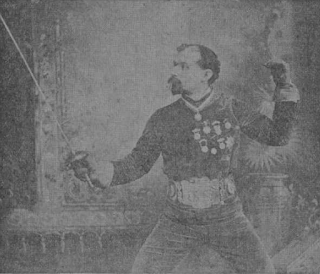
It is only after Pini, Greco, and Pessina have left the country that Pavese begins to receive individual attention from the American press. As early as February 1894, only a few weeks after the Italian masters departed, Pavese had begun challenging various east-coast fencers and organising public contests, with the Brooklyn Daily Eagle calling him the 'champion of Italy'.6 Another article promoting the same event claims Pavese is a student of one 'Pessini' (likely Pessina), the 'recognised champion swordsman of the Italian army in Italy'.7 Following this event, one newspaper says that Pavese was 'formerly a lieutenant in the Italian army, but is now a shoemaker in Newark'.8

In May of that same year, Sfrisi too is named the 'champion of Italy' in a Connecticut newspaper promoting his upcoming exhibition against fencing master Etienne Postel and amateur Helen Englehart.9 While Sfrisi does not appear in any subsequent events in America (he would eventually return to Italy and continue to teach fencing), for Pavese the year 1894 would be the start of over a decade of challenges and public contests all across the United States, seeking out publicity wherever he could.

European Champion

America would be home to many other self-proclaimed masters and champions from Europe aside from Pavese (subjects for future articles, perhaps), but none ever received quite so much media attention as he. The 1890s would be a particularly popular time for these pretenders, and not just those hailing from Italy. Newspapers throughout the country advertised public contests involving 'champions' of America, England, Germany, Russia, and France, many of whom Pavese would encounter at some point in his career.

Aside from the aforementioned Sfrisi, another person declaring himself the 'Italian champion' in 1894 was one Greco Martino. Having seen Pavese's claims of being the champion of Italy, Martino had a letter of his published in New York's National Police Gazette proclaiming that he was the 'legitimate' champion of Italy, having held the title for 8 years, and that not only was Pavese a fraud, but Martino had never even heard of him before. He challenged Pavese to a contest, claiming he can defeat him in only 10 minutes, but it is unclear if this ever eventuated.10

Needless to say, none of these three men had ever held a 'championship' title in Italy, nor did any such title even exist. Not only that, but no competitive record can be found for either Pavese or Martino; Luigi Sfrisi is the only one of these three with any verifiable background in Italy. What is known about Sfrisi's career up to this point is that he was a sergeant and fencing instructor at the cavalry normal school in Pinerolo before attending Parise's military fencing master's school in 1885, and that he was classified in the second category for masters in both sabre and foil at the 1891 Bologna tournament.11

As for Pavese, a later article claimed that he had performed excellently at the Florence 1887, Rome 1889, Bologna 1891, and Venice 1891 tournaments,12 and the preface to his own treatise claims:

During the years 1889, 1890, 1891 and 1892 he attended and took part in all the principal fencing tournaments in Italy, France, Spain and Austria, and gained distinguished honors at his every appearance.13

Most of the major tournaments in this period are well-documented in newspapers and sporting magazines, particularly in France and Italy, and sometimes a tournament committee would publish their own report with a comprehensive list of competitors and their results. The cited tournaments of Florence (1887), Rome (1889), and Bologna (1891) were particularly significant tournaments at the time, and so although their mention suggests Pavese was well-informed of the Italian competitive scene, his name is absent from all the articles and reports that discussed them.14

Even the renowned French masters Mérignac, Prévost, and Rouleau are specifically listed as having been defeated by Pavese on a trip to Paris along with Eugenio Pini in 1892.15 This claim came to the attention of the French newspaper Le Journal, commenting that they do not recall having ever seen Pavese in Paris, and that if he had indeed defeated all these masters, it would have been highly publicised.16

In January 1905 Mérignac came to New York to give an exhibition, inviting all local fencers to take part, Pavese included.17 Having taken issue with Pavese's claiming to have defeated him in the past, Mérignac singled out him as soon as he arrived in the country, with both supposedly agreeing to a challenge of two 20-minute sabre bouts and two 20-minute foil bouts to decide world championship.18 It does not seem like this challenge ever took place, and Pavese did not attend the exhibition in New York, with the Boston Globe saying he had 'engagements elsewhere' and sending his student Count Magnoni in his place.19

The only tournament outside of America I have been able to find Pavese taking part in was during his trip to Europe in 1905. At an international foil tournament in Paris, Pavese was eliminated in the first round by a French military fencing master named Molinié, who would end up in 6th place.20 Mentions can also be found of small exhibitions organised by Pavese in Italy in the same year, but he seems to have avoided the all the other tournaments which took place around the continent during that time.21

Duellist

The image of a seasoned duellist, ever-ready to heroically defend his honour by the sword, is a significant part of how Pavese promoted himself in America. Italians in general already had an international reputation for a 'fiery temperament' by this time, and Pavese seemed happy to play along with this stereotype, challenging his American opponent to a duel if a particular bout was not judged in his favour, or even just as an alternative to a contest with blunt weapons.22 In a brief yet enthusiastic report of a public exhibition of his in 1896, the Boston Post wrote:

Brave men who are skilled in handling the foils would accept an insult rather than challenge this man to an encounter. Pavese has had many a battle, and could tell some thrilling stories, many of them having a coloring of love. His career has been romantic, and he has to stop and think before he can tell you the number of duels he has fought.23

In the first few days of the Spanish-American War, Spanish naval attaché (later revealed to be a spy) Lieutenant Ramon de Carranza challenged General Fitzhugh Lee and Captain Charles Dwight Sigsbee to a duel after the latter two accused Spain of blowing up the USS Maine.24 Recognising an opportunity for celebrity, or perhaps even out of genuine patriotic zeal for his adopted homeland, Pavese responded to this challenge on behalf of Lee and Sigsbee with a letter published in the New York Evening Journal.

The accompanying article describes how Pavese has fought in a number of duels, emerging victorious each time, citing duels with a Rodriguez in Madrid, Count Cotini of Aversa, a Cardacci of Naples, a Fiorontini of Belgium, and Giuseppe Grasso of Parma.25 Whilst this list of specific names and locations lends an air of credibility to Pavese, there are a couple of underlying issues with his story.

Firstly, although he states in his letter his desire that the 'challenge issued by you [Carranza] to General Lee and Captain Sigsbee should not go unanswered', there had been multiple other gentlemen putting their names forward publicly as replacements for Lee and Sigsbee weeks before Pavese did (with no reply from Carranza).26 Secondly, although some of the names listed in the article from the New York Evening Journal would reappear in future media attention around Pavese (who certainly did not miss an opportunity to recount his challenge to Carranza), the details surrounding his prior duels and the Carranza affair itself would become more dramatic and change in future retellings.

An article from the Denver Evening Post in 1899 highlights how quickly this mythology would develop. It claims Pavese had had 'something like twelve duels', with two of them being fatal for his opponent; he is said to have thrust Martinez through the chest in Barcelona in 1887, and 'Cardac' was stabbed through the heart in Madrid in 1888. It then gives an elaborate account of how his duel with Count Cotini came about, even requiring the Italian minister of war to give his personal approval to 'fight for the honor of the regiment.'27 The article says the duel took place in November 1898, but given that Pavese had long been in the USA by that time, this was probably meant to be 1888. The minister cited is Cesare Ricotti-Magnani, and while he did indeed serve as Italian minister of war several times, he was not the acting minister of war in either 1888 or 1898.28

A recurring theme in the retellings would be his two fatal duels against Frenchmen, with the aforementioned Cardac/Cardacci, supposedly a famous French fencing master, being the most commonly mentioned (albeit with several spelling variants), but the chronology, locations, and total number of duels were inconsistently recalled.29 Whilst the number and nature of the duels attributed to Pavese are not unprecedented in the period, the unverified participants and the deaths of two make the narrative extremely unlikely. Despite the frequency of duels themselves, it must be noted that duels which resulted in death were a rarity in Western Europe by this time, and were thus always subject to avid media coverage, particularly if the one who died was a famous French fencing master, as Pavese claims.30 No record can be found of any duels in which Generoso Pavese was involved, nor any of the supposed victims.

Regardless of how true Pavese's duelling past was, his characteristic hot-headedness seemed to be largely beneficial to his reputation. It was through this eagerness to hand out duelling challenges that he would end up meeting President Theodore Roosevelt in 1903, who was supposedly impressed by Pavese's chivalric conduct when he challenged the French fencing masters Lucien Mérignac and Alphonse Kirchhoffer to a duel when the French press claimed the latter two convincingly defeated their respective opponents, Francesco Pessina and Franco Vega, in a duel in December 1902. It is hard to know if the Frenchmen actually received their challenge from Pavese, or even cared, but the result was that Pavese was given an opportunity to meet with the U.S. President, and was for some time said to be his fencing master—a story which caught the attention of both American and European newspapers.31

As for the Carranza affair, some articles would claim that Pavese travelled to Canada to personally challenge Carranza to a duel, which he refused, even attempting to follow the Spaniard back to Madrid.32 As with the others, no record can be found of this duel taking place, and passports and passenger listings can be found under his name which indicate that the first time he left the American continent since his arrival was his aforementioned trip to Europe in 1905.33

Military Fencing Master

Along with his self-given title of 'champion of Italy' and later 'world champion', from early on many newspapers also referred to Pavese as a 'professor', a title commonly used in English for fencing masters.34 As there were no federal governing bodies for the title of fencing master in America at this time, it could take as little as declaring yourself a fencing master or giving lessons on a regular basis to be considered as such. Italy, on the other hand, had a much more established culture for the certification of fencing masters—especially within the military, where Pavese is said to have earned his qualification.

In the preface of Pavese's treatise it states that he joined the military voluntarily, serving in the 19th cavalry before being accepted to the internationally-renowned military fencing master's school in Rome, then returning to his old regiment as a fencing master after graduating.35 A similar background is given articles from the Washington Times and Baltimore Sun, with the former saying that he was the fencing instructor of the 19th cavalry for eleven years, and the latter that he attended the school from the age of 16 to 27, acting as the fencing master of the 19th cavalry for only some of that time.36

Contrary to all this, however, in a feature article on Pavese in the New York Sun from 1903, it claimed that at the age of seventeen Pavese entered the 'instruction platoon' (i.e. the cavalry school) in Pinerolo, where his talent for fencing was noticed, resulting in him being admitted to the Rome fencing master's school in 1885. After graduating in 1887 with honours, he 'remained there until 1887 [sic] when he was ordered by the Italian Government to leave school and join his regiment—the Ninth Cavalry.' The same article says that while Pavese was at the school he was fortunate to have studied under 'three of the best swordsmen ever known: Professors Carlo Pessini, Doni and Peresi'.37

The first of these names refers to Carlo Pessina, a prominent instructor at the school, and the third is likely meant to be Masaniello Parise, the school's director. The second of the three, likely one Vittorio Doni, was indeed a military fencing master, but he is not known to have been teaching there at the time, albeit he did attend a 4-month course at said school in the first half of 1885, after which he would have returned to teaching in his regiment, coincidentally the 19th cavalry.38 It will also be remembered that the aforementioned Luigi Sfrisi was teaching at the Pinerolo cavalry school in 1885, so it is possible that Pavese has some history with him too.

While it is conceivable that Pavese could have taken part in the entrance exam, there is no evidence to suggest that he ever attended the military fencing master's school and subsequently graduated. Lists of the people who were accepted into the school were published in the official military journal, as were the start and end dates of its courses. He also cannot have been a student at the school if articles from December 1893 were correct in stating that he was an army officer, as only sergeants were admitted.39

Nor did the unverified claims about his military service end after his time Italy. On his death, obituaries in the New York Times and Baltimore Sun say he served as a cavalry captain under Teddy Roosevelt in the Spanish-American War, with the two being 'close friends'. This is, unsurprisingly, entirely unsubstantiated, with the 1930 federal census clearly stating 'no' in the column marking veteran status of the U.S. navy or military.40

While evidence indicates that he was never a qualified military fencing master in his native Italy, it is not unlikely that Pavese was involved in the military to some degree, perhaps training at the Pinerolo cavalry school, given his recognised ability for horse riding, as shown in various mounted tournaments throughout his career, and his constant desire to associate himself with military pursuits. This desire manifested itself even in his later life, when he founded a Fascist youth 'military school' in Baltimore in the late 1920s, modelled after the 'Balilla' organisations of Fascist Italy.41

Unlike Pavese, a Florentine civilian fencing master named Marco Piacenti did have an established competitive reputation throughout Europe first as an amateur, then becoming a master in 1898. Shortly after this he moved to Boston, where he would teach at the local athletics club for a few years before returning to Italy.42 As someone who was very active in the fencing scene the same time as Pavese claims to have been, Piacenti would be in perfect position to verify Pavese's integrity and merit as master, but this he never did. On the contrary, in an 1899 article by Piacenti published in the Boston Sunday Post, he denounces the 'self-styled fencing teachers' who come to the USA looking to profit off their lies, as well as giving a plausible reason as to why this phenomenon was so prevalent at the time:

Fencing in North America is without doubt the branch of sport which is least valued here, and the cause of this is that there have come to this country a great number of self-styled fencing teachers who have adopted a method that is neither the French nor the Italian method, and which has disgusted many Americans with fencing altogether, as they have not had a chance to see its artistic side. In fact while we see hundreds at a fencing tourney in Italy or France only about twenty amateurs will come together at such a tourney in a great city like Boston.
The reason is that the persons who come to this country have no profession, and in order to make their living begin to teach fencing, of which they do not know the first rudiment.
In this first year of my teaching in Boston I have seen people with a very good disposition for fencing and also with a very fine constitution for this sport, but they had been spoiled by their former teachers.
[...]
I sincerely hope that a good fencing teacher, Italian or French, will soon come to this country, and that this highly interesting sport will then eagerly be taken up by those who now take no interest in it.43

American Champion

It would be a whole other article in itself to thoroughly address Pavese's competitive career in the USA, so for this article it will suffice to demonstrate how his lack of credibility regarding other aspects of his life also manifested in this realm. From late 1894 until the late 1910s, Pavese insistently promoted himself as 'champion of the world' (and, later, that he remained undefeated) at a time when several others in the USA were also giving themselves the same title.

American news media were, by and large, happy to entertain these claims even in spite of several public defeats and withdrawals on the part of Pavese. In April 1894 a contest between Pavese and the multi-talented sportsman Duncan C. Ross ended early when enraged Italian spectators stormed the stage to protest perceived bias from the referee in favour of Ross. The two would meet at least twice more in the future, both times with the match ending prematurely in similar circumstances.44

In March 1897 Pavese was decisively defeated by an Italian fencing master named Francesco Scannapieco in Philadelphia, but again he would continue to proclaim his title as world champion, denying his defeat by Scannapieco.45 A defeat that received more publicity took place in San Francisco in 1899 against the French master Louis Tronchet, with the hot-headed and outraged Pavese declaring 'his willingness to meet Tronchet in mortal combat in Montreal or Mexico'.46

None of this is to say that Pavese was a particularly bad fencer, at least by American standards. Pavese taught and successfully fenced in public for over a decade, earning the admiration of many; however, given that some of the public bouts occurring this time involved prize money of up to $1,000 for the victor (over $30,000 in today's money), anyone's public boasting of American or world championship or of being undefeated should, as a default, be taken as little more than self-promotion for the sake of profit.

The Treatise

So with all this said—having thoroughly demonstrated that not only did Pavese lie about his background and career, but inconsistently so—what does this mean for his treatise? While Pavese himself says he drew from from Masaniello Parise's 1884 treatise Trattato teorico-pratico della scherma di spada e sciabola to some degree, the fact that Pavese likely did not attend the Parise's military fencing master's school in Rome means that any additions or original insights that may be found in his book cannot be assumed to derive from what was taught at said school. However, since nothing is yet known about Pavese's fencing experience during his time in Italy, it cannot be said for sure that he was not taught Parise's method.

If Pavese did grow up in the Naples area, it is certainly possible that he could have received lessons from Masaniello Parise prior to his appointment to the Rome school or any other member of the Parise family of fencing masters who were active during Pavese's youth. In short, the uncertainty of Pavese's fencing pedigree does not entirely negate any value that might be obtained from his treatise, but it cannot in good faith be considered representative of any particular lineage or institution until more insight is gained into his early years. What one can do is determine how much his book draws from Parise's material, where he diverges, and if any other possible influences are evident. While a comprehensive comparison would be beyond the present scope, there are a few aspects of the book which I feel are worth highlighting.

Starting with the foil, the more visually obvious divergences from Parise's method are seen in his guard position, which appears more evenly-weighted rather than Parise's slight rear-weighting, as well as in Pavese's lunge, which is more akin to what's prescribed in northern Italian masters such as Masiello, with a forward lean creating a straight line from left shoulder to left heel, a movement which Pavese explicitly describes as being 'very important'.47
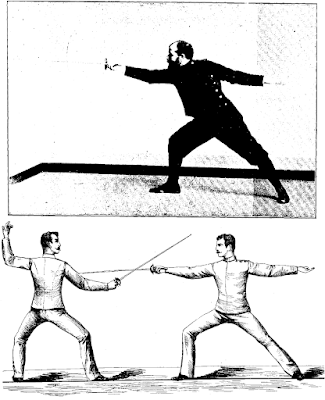
Top: Pavese
Bottom: Parise

Aside from the regular step forward or 'step in advance', Pavese also describes what is commonly known today as the balestra or jump forward, a technique that had only recently started to be described in Italian treatises.48 Also curiously modern is part of his terminology, that being his designation of parry of 1st what was usually referred to in contemporary Italian terminology as 'half-circle' or less commonly 'parry of 5th'. In the Italian school it would be more common later in the 20th century for the term 1st or prima to be used to refer to both the French-style pronated parry and the supinated 'half-circle' parry, but not so in 1905, making Pavese an outlier in this respect.

His sabre section is even more abridged than the foil, with many noteworthy omissions. Both Parise's 'yielding 6th' parry (otherwise known as parry of 7th) as well as his guard of 1st, Parise's preferred engaging guard, are both missing. The exercise molinelli are entirely absent, but he preserves their drawing recovery swing in the individual cuts. He also removes Parise's prescribed obtuse angle between the extended arm and sabre when cutting, instead preferring to maximise reach with a straight line from shoulder to point.

Pavese's unique addition of the 'Form for Articles of Agreement'—a bouting contract seemingly inspired by those used for duels—and the advice he gives about fencing equipment and bouting culture are an admirable attempt by the author to adapt the material for an American audience—that is, one which had far less general cultural awareness of fencing and was accustomed to different public events compared to those in Western Europe. His work gives the impression of a man who was determined to continue promoting the art in spite of the cultural apathy he encountered both before and after the treatise's publication.

Conclusion

The typical approach to understanding a historical figure or event is, essentially, through examining as many reliable sources as possible to determine what happened and why. The challenge that became apparent in writing this article is a good demonstration of how difficult it is to convincingly prove something did not happen. At what point does the absence of evidence become sufficiently overwhelming to conclude that a particular event did not take place, or at least not how another source might claim so?

Through the extensive examination of government records, newspapers, sporting magazines, tournament reports, and military journals, no evidence of Generoso Pavese's fencing career in Italy was found during the period he claims to have been not only active, but renowned to some degree in the Italian fencing scene. Even after arriving in the USA and receiving considerable attention from media institutions around the country, the claims made by and about him were often contradictory, provably false or greatly exaggerated. Although these claims may weave a compelling narrative, they misleadingly depict Pavese as belonging to a particular class of fencing masters whose qualifications made them highly regarded around the world, therefore presenting a tempting opportunity for those willing to exploit this reputation for personal gain.

The method he describes in his treatise cannot be be considered a product of Italy's military fencing master's school due the unreliability of his narrative, but despite this Pavese's treatise remains an interesting example of one person's attempt at propagating the modern Italian school of fencing in the USA before the more successful attempts later in the century.


1 A good summary of this period of Italian immigration can be found on the website of the US Library of Congress: "Immigration and Relocation in U.S. History," accessed 9 January 2022, https://www.loc.gov/classroom-materials/immigration/italian/.
2 Generoso Pavese, Foil and Sabre Fencing (Baltimore, MD: King Bros., 1905).
3 Id., p. 5.
4 For the 1905 passport application: National Archives and Records Administration (NARA); Washington D.C.; Roll #: 669; Volume #: Roll 669 - 01 Feb 1905-28 Feb 1905. Note also that on his death in 1947, some obituaries gave his place of birth as Florence. See "Noted fencer dies at 81," Baltimore Sun, 16 January 1947, 10; "Generoso Pavese," New York Times, 16 January 1947, 25.
5 American articles: "With steel blades," New York World, 8 December 1893, 9; "Italy's master of fencing," New York Times, 8 December 1893, 3. Italian articles: Accademie, Tornei e Notizie, Scherma Italiana, 16 November 1893, 84; Accademie, Tornei e Notizie, Scherma Italiana, 1 January 1894, 6–7; Accademie, Tornei e Notizie, Scherma Italiana, 13 January 1894, 12.
6 "A mounted sword combat," Brooklyn Daily Eagle, 22 February 1894, 8.
7 "To cross swords," Brooklyn Citizen, 22 February 1894, 3.
8 "Parvese defeats Kendal," New York Daily Tribune, 12 March 1894, 3.
9 "Music and fencing," New Haven Daily Morning Journal and Courier, 16 May 1894, 2.
10 National Police Gazette, 28 April 1894, 11.
11 For his attendance at the fencing master's school: Cesare Francesco Ricotti-Magnani, "N. 90. - Corso speciale presso la scuola magistrale di scherma. - (Segretariato generale). - 27 luglio," Giornale Militare 1885: parte seconda, no. 31 (30 July 1885): 340–1. It is also likely Sfrisi took part in the last course to be held at the Milan master's school before its closure, as mentioned in Cesare Francesco Ricotti-Magnani, "CIRCOLARE N. 73. - Ammissione di sottufficiali ad un corso speciale presso la scuola magistrale di scherma. - (Segretariato generale). - 20 giugno," Giornale Militare 1885: parte seconda, no. 26 (23 June 1885): 293. For his participation in the Bologna tournament: Carlo Pilla, Torneo nazionale di scherma 3-7 maggio (Bologna: Società tipografica già compositori, 1891).
12 "He'll teach Roosevelt to fence," New York Sun, 15 February 1903, 8.
13 Pavese, Foil and Sabre Fencing, 5.
14 Some sporting magazines that covered fencing tournaments are L'Escrime Française for France, Scherma Italiana for Italy, and Allgemeine Sport-Zeitung for Austria. For the 1887 Florence tournament, extensive coverage is found in the Florentine newspaper La Nazione throughout May 1887. For the 1889 Rome tournament, see various articles in large newspapers such as Turin's Gazzetta Piemontese, Milan's Corriere della Sera, and Rome's La Tribuna in November 1889. For the 1891 Bologna tournament, see Pilla, ibid. For the 1891 Venice tournament, a report is found in Baiardo: periodico schermistico bimensile from 8 September 1891.
15 "He'll teach Roosevelt to fence," New York Sun, 15 February 1903, 8.
16 "Escrime," Le Journal, 24 November 1904, 6.
17 "Master of the foil coming to America for matches with Yankee swordsmen," Indianapolis Sun, 11 January 1905, 7.
18 L'Auto, 6 January 1905, 1.
19 "Rondell's great fight," Boston Globe, evening edition, 25 January 1905, 3.
20 "Escrime," L'Auto, 1 April 1905, 5.
21 "Sport," Don Chisciottino, 4 June 1905, 3; "Scherma," Il Vaglio, 1 July 1905, 3.
22 "Pavese dares Tronchet to fight to the death," San Francisco Call, 6 November 1899, 6; G Pavese, "Pavese will fence Senac," National Police Gazette, 23 March 1901, 11; E. G. Westlake, "Who Is the Fencing Champion of the Western Continent?," Columbus Daily Herald, 27 April 1901, 3.
23 "Austin & Stone's," Boston Post, 14 April 1896, 6.
24 "Challenged to a duel," New York Times, 26 April 1898, 4.
25 "Pavese ready to fight Spaniards," New York Evening Journal, 9 June 1898, 6.
26 "Capt. Stahl Challenges Carranza," New York Times, 28 April 1898, 7; "Gen. Lee back in Washington," New York Times, 29 April 1898, 3; "W. D. Ballari wants to Fight Carranza," New York Times, 30 April 1898, 4.
27 "Pavese's sword," Mexican Herald, 22 October 1899, 13, extract from Denver Evening Post.
28 Parlamento Italiano, "Cesare Ricotti Magnani," viewed 10 February 2022, <https://storia.camera.it/deputato/cesare-ricotti-magnani-18220130/governi>
29 "Pavese dares Tronchet to fight to the death," San Francisco Call, 6 November 1899, 6; "Swordsman Pavese In Town," Baltimore Sun, 20 October 1901, 6; "Swordsman Pavese accepts," Baltimore Sun, 20 May 1902, 6; "He'll teach Roosevelt to fence," New York Sun, 15 February 1903, 8; "Fencing bout arranged," Altoona Mirror, 2 March 1909, 6; "Prof Pavese, Teddy's sword master, open for business; want a date?," Tacoma Times, 14 April 1909, 2.
30 According to Gelli, less than 2% of duels in Italy from 1 June 1879 to the end of 1889 resulted in death. Jacopo Gelli, Statistica del duello (Milan: Tipografia degli Operai, 1892).
31 "He'll teach Roosevelt to fence," New York Sun, 15 February 1903, 8; "Master of the rapier," The Argus, 21 February 1903, 10; "President's skill with foils," Washington Times, 5 October 1904, 7; "Escrime," Le Journal, 24 November 1904, 6; "Roosevelt allievo di un schermidore italiano," Gazzetta dello Sport, 28 November 1904, 2.
32 "Prof. Pavese, Teddy's sword master, open for business; want a date?," Detroit Times, 21 April 1909, 4; "An expert swordsman," Waterbury Evening Democrat, 4 May 1899, 4.
33 Aside from the passport cited in footnote 5, the only passenger listing I have found so far with containing Pavese's name is on his return in 1905: Year: 1905; Arrival: New York, New York, USA; Microfilm Serial: T715, 1897-1957; Line: 15; Page Number: 64
36 "A mounted sword combat," Brooklyn Daily Eagle 22 February 1894, 8; Miscellaneous Sports, New York World, 30 May 1894, 2; "To cross swords," Brooklyn Citizen, 22 February 1894, 3.
35 Pavese, Foil and Sabre Fencing, 5.
36 "Prof. Pavese and his claims for the Italian school of fencing," The Washington Times, 6 July 1902, 28; "Swordsman Pavese in Town," Baltimore Sun, 20 October 1904, 6.
37 "He'll teach Roosevelt to fence," New York Sun, 15 February 1903, 8. An aforementioned article from 1894 also mentions a 'Pessini' as Pavese's master: "To cross swords," Brooklyn Citizen, 22 February 1894, 3. The Baltimore Sun of 21 July 1904 instead claims that Pavese was 'two years riding master at one of the leading cavalry schools of Italy'.
38 Cesare Francesco Ricotti-Magnani, "N. 2. - Corsi eventuali presso la scuola magistrale militare di scherma. - (Segretariato generale). - 2 gennaio," Giornale Militare 1885: parte seconda, no. 1 (7 January 1885): 2–3.
39 Lists of successful applicants to the Rome fencing master's school during this time may be found in the following issues of the Giornale Militare: 3 October 1884, 7 January 1885, 15 April 1885, 27 July 1885, 4 March 1886, 23 September 1887, 18 August 1887. Some students who were known to have attended the school do not appear in these lists, but they such instances are rare. It must also be noted that the comprehensive directory of military officers contained in the annual yearbook Annuario Militare del Regno d'Italia does not list a Generoso Pavese at any point in the 1880s or 90s.
40 Claims of military service: "Noted fencer dies at 81," Baltimore Sun, 16 January 1947, 10; "Generoso Pavese," New York Times, 16 January 1947, 25. For his census entry, see U. S. Federal Census. Year: 1930; Census Place: Baltimore, Maryland; Page: 1B; Enumeration District: 0577; FHL microfilm: 2340591.
41 "First Fascist School Opened in Baltimore," Daily Worker, 19 June 1928, 4.
42 Biographical details on Marco Piacenti: P. B. [Pietro Baldi], "Marco Piacenti," Gazzetta dello Sport, 18 March 1898, 1; "Le Maitre Piacenti," Les Armes, 5 June 1910, 250. Piacenti's tournament achievements are easily verified by contemporary newspapers and sporting magazines, such as the Italian Scherma Italiana and the Hungarian Sport-Világ. Piacenti was classified in the 1st category in both foil and sabre at the tournaments of Genoa 1892, Venice 1894, Milan 1894, Prague 1895, and Budapest 1896, among many others.
43 Marco Piacenti, "Marco Piacenta on fencing," Boston Sunday Post 7 May 1899, 21.
44 "Broadsword contest ended in a fizzle," Brooklyn Standard Union, 9 April 1894, 8; "Boxing resumed at Coney," New York Sun, 2 August 1894, 5; "Broadswordsmen in danger," New York Sun, 10 September 1895, 5.
45 "Scannapieco Won the Championship," 11 March 1897, 5. This defeat did not go unnoticed by all, however, with the Wilmington Sun commenting on an event of Pavese's in New York the following year: 'Professor Pavese, of New York, who, although easily beaten by Professor Scannapieco, claims the fencing championship of the world ...' (31 March 1898, p. 3).
46 "Pavese dares Tronchet to fight to the death," San Francisco Call, 6 November 1899, 6.
47 Pavese, Foil and Sabre Fencing, 127.
48 Other early examples are found in: Luigi Barbasetti, Das Stossfechten (Vienna: Wilhelm Braumüller, 1900); Primo Tiboldi, La scherma di fioretto (Milan: Casa Editrice Sonzogno, 1905).

25 January 2022

Fechten im Bild by Hans Murero

This most recent addition to my personal collection entitled Fechten im Bild (literally 'Fencing in picture') is more of a novelty than your standard fencing treatise, since instead of relying on text, it predominantly consists of photos of various fencing positions for sabre, foil, and épée (36 photos, to be exact), with the methods shown for the first two weapons based heavily on the Barbasetti lineage.

Scans: https://drive.google.com/file/d/1loO_vQf83bWzHwPwPBBfBopD65PC8zww/view?usp=sharing


Its author, Hans Murero, was born in 1881 in Klagenfurt, Austria, and was a graduate of the Wiener-Neustadt school, studying under the renowned Milan Neralić, himself a student of Luigi Barbasetti. Murero remained at the Wiener-Neustadt school as an assistant instructor until Neralić hired him as his assistant in Berlin. Murero was recalled to the Wiener-Neustadt school during the First World War, after which he spent some time teaching at the Wiener Athletiksport-Klub and Union Fechtclub in Vienna, eventually returning to teaching in Berlin, where he died of laryngeal disease in 1930.

Sources

"Hans Murero," Allgemeine Sport-Zeitung, 2 February 1919, 1067.

"Michael Neralić," Allgemeine Sport-Zeitung, 24 February 1918, 60.

"Tagesneuigkeiten," Neues Wiener Journal, 24 May 1930, 9.

09 January 2022

Vittorio Argento on Neapolitan sabre fencing

Throughout the 19th century, sabre fencing in southern Italy was always considered a secondary discipline to sword (foil) fencing, a preference which its proponents justified by looking to the centuries-long tradition their region boasted in this regard. In this article from Gazzetta dello Sport, published 18 & 21 August 1899 under the title 'La scherma di sciabola a Napoli', journalist and amateur fencer Vittorio Argento takes stock of the last century and highlights the individual Neapolitans who went against the traditional neglect for sabre and instead elevated it to new heights, citing such names as Augusto Parise, Vincenzo Bellini, Gaetano Barraco, and Saverio Cerchione.


Sabre fencing in Naples

By now the custom of giving little consideration to the handling of the sabre, widespread amongst the majority of our fencers, has almost completely stopped; but once, not too long ago, if this weapon was not held completely in contempt, it was not appreciated according to its true value.

And to think that even then most duels were done with sabres!

What a contradiction! Fencing enthusiasts who can never believe they have trained enough with the sword, who sacrifice most of their time to the handling of this weapon and give it the utmost importance—in the only case in which it should be of use to them, they set it aside and choose the sabre as their preferred combat weapon, perhaps due to the preconception of thinking it less capable of producing mortal wounds; as if it were not possible to thrust with a sabre, or as if, even excluding murderous intentions in duels, cuts were not often fatal too. But let us not get off-track.

So there were very few who sometimes deigned to take the sabre in hand, and those rough wooden scimitars stayed hanging in fencing halls, full of cobwebs and almost never being disturbed.

If a master was asked by some students for a sabre lesson, he immediately tried to dissuade them.

Why waste time with the sabre? The art, the true art of fencing consists in sword fencing. Those who wield this weapon well can also wield the sabre as a consequence. With this conviction they pushed on.

Nor was there reason to be disillusioned, because in the event—and this was a rare event—that two fencers, recalcitrant to their master’s advice, wished to indulge themselves by having a sabre bout, being at the same level, they certainly could not have realised their own deficiency.

This is the rate at which it progressed for so many years, with the known offensive actions confined in the limits of backhands and double backhands, forehands and double forehands, vertical strikes, horizontal strikes, etc., more or less like in the old spadancia fencing system. Defence consisted of attacking with the aim of saving oneself with body parries; parries were rarely done by opposing one’s own blade to the opponent’s.

This was the state of things when Maestro Augusto Parise returned from Modena, where he had been a fencing teacher for some time at the military school, and where he had had the opportunity to train in handling the sabre with his other colleagues, especially with Enrichetti, Simonetti, Lupi, Pavia, and Pinto. He opened a fencing hall in our city, dedicating himself primarily to the teaching of sabre fencing and introducing us to steel blades for the first time.

With the first boost from this master, sabre fencing gradually began to be cultivated with greater care even in other halls, and the masters Annibale, Raffaele, and Eduardo Parise, Giuseppe Lopez, Vincenzo La Marca, Giuseppe Zugiani, and many distinguished amateurs such as Morbillo, Miceli, Rizzo, and Anzani were also strong sabreurs at that time. But soon these fencers preferred the sword again, which, through its limited target to be defended and the numerous means of defence which it offers, is less exposed to surprises and better lends itself to a serious and rational game.

One who with rare perseverance, and more through his own intuition than through any training acquired, cultivated and kept sabre fencing alive in Naples was the young amateur Vincenzo Bellini, then a medical student. He set about it with such passion that he almost totally abandoned his studies in order to devote himself exclusively to the profession of this art. I do not think he had anything to regret. Working tirelessly, he was able to produce many strong fencers, first and foremost Locascio.

He also published a treatise about his system which may be criticised, discussed, perhaps found incomplete; but the conscientious critic cannot help but consider that it was edited when the teaching of sabre was in a rudimentary state, lacking in exact rules and a rational progression, and that any art in its first development is subject to continuous changes before being able to approach perfection.

Besides, if Maestro Bellini publishes a new edition of his treatise, it will immediately be seen if and in what manner he will have followed and appreciated the continuous progress made by sabre fencing in recent times.

Those who have given the greatest influence to sabre fencing were, without any doubt, the military masters who went on to the various regiments stationed in Naples and nearby cities or at the Nunziatella military college.

The masters Monti, Pessina, Cerchione, Pagliuca, Barraco, Nappi, Cafarelli, Macri, Marenco, and so on—strong young men, willing to work and eager to show their valour—presented themselves in all the exhibitions, participated in all the fencing gatherings, frequented the best halls, fencing with sword and sabre, but naturally giving preference to the latter, which is the soldier’s weapon.

To see these young masters fence sabre, our fencers were convinced—from the evidence of the facts—that as strong as they were with the sword, they were completely insufficient with regard to the sabre. They started to give up the prejudice that this weapon was something like a coachman’s whip or a goatherd’s stick, and instead became persuaded that in the hands of someone who knew how to use it well by cultivating its handling with accurate and conscientious study, the sabre lent itself to a more elegant and finer game, no more or no less than the foil, and they devoted themselves—some with their own master, others with some of the best military masters—to training in the handling of the sabre.

It was then that Maestro Barraco, either through kindness or by his own choice, took leave of the army and opened in Naples the hall which produced Giuseppe Del Pozzo, Giuseppe Morelli, Aspreno Brancaccio, Luca Caracciolo, Captain Roberto Galato, Gaetano Fernandez, Enrico Formento, and others.

By staying faithful to a single system, Barraco—a profound connoisseur of his art, a strong fencer and intelligent teacher—would have been able to create students who should have all been similar, both in handling the weapon as in the tactics of fencing; but his restless spirit, the passion of always wanting to find new things, induced him to bring continuous innovations into his system, such that his students often differed from each other to the point that they seemed to be trained in different schools; and if this did not diminish the merit of the individuals, it did cause the lack of a standard which should have distinguished his school from all the others.

Now sabre fencing in Naples has progressed in a truly admirable way, especially in the last ten years.

Having witnessed public and private bouts with Pessina, Greco, Cerchione, Pecoraro, Guasti, Drosi, Conte, Nappi, Caprioli, Marenco, Mormile, Campanella, Burba, and many many other famous masters and amateurs, who, in being strong fencers, became very likeable through the grace of their movements, the plasticity of their pose, and above all the precision and lightness of their blade carriage, which has been so useful that our sabre fencers have slowly begun to refine their game, to force themselves to dominate the blade, guiding it until it barely touches—I would almost say grazes—the opponent. Those huge deep sea diver helmets, those padded vests which made sabre fencing so clumsy have almost completely gone into disuse. In Cerchione’s hall, for example, where the cream of sabre fencers is found, such as Filippo Salvati, Marquis Mastellone, Giuseppe Giurato, masters Russomando, De Simone, Galimi, etc., they fence with light jackets and often even with foil masks and foil gloves; nor once the bout has ended does one ever see those bruises on the chest that were seen (despite the padded vests) when cuts were given by letting the blade fall on its own.

In short, if we do not have that great number of strong sabre fencers that we should have, taking into account the number of inhabitants in our city and how many of them, it is said, study fencing, on the other hand we have fencers who are greatly esteemed and appreciated by the strongest masters and amateurs of Italy and who can, without fear of being accused of presumption, aspire to making those people reconsider who once rightly asserted the Neapolitans to still be children with regard to sabre fencing.

Vittorio Argento

06 December 2021

Austro-Hungarian fencing sabres in the 1890s

The comparative lightness of Italian fencing sabres was something that foreign commentators took particular note of in the 1890s as Italian fencing weapons and styles received ever more exposure throughout Europe, particularly within Austria-Hungary. An aspect of this that is often overlooked, however, is what these observations can tell us about the fencing cultures of the Austro-Hungarian empire prior to the explosive spread of Italian sabre fencing with the arrivals of Luigi Barbasetti and Italo Santelli. In short: if Italian sabres were considered light, what were the sabres like in Austria-Hungary?

Fencing equipment — Udrycki de Udryce (1879)

Although there were some distinct moments in which Italian sabre fencing gained notable footholds within Austria-Hungary in the 1890s, it must be kept in mind that this influence did not begin at a single moment in time, nor was it felt equally in all corners the vast empire. Former Italian military fencing master Pietro Arnoldo had been established in Graz since the mid-1870s, forming his own local contingent of Italianate sabreurs,1 and several Radaellian masters had taught in Trieste (then part of Austria-Hungary) since 1881.2

Despite this, it would not be until after Barbasetti's arrival in Vienna in 1894 that Italian influence spreads throughout Austria proper, and the fencing masters of Budapest would not adopt Italian fencing customs until there became a demand for it following the 1896 Budapest 'Millennium Tournament' and the arrival of Italo Santelli. Italian influence would take several years to reach most of the major cities of the empire, either through directly hiring a master from Italy, or by acquiring a recent graduate of the Wiener-Neustadt school (following its reorganisation by Barbasetti in 1895). Italian influence was therefore quite localised initially and took place at varying rates.

Due to the my own linguistic limitations and the greater prevalence of sources from Austria and Hungary, this article will focus on the evidence from just these two regions, with a particular bias towards the cities of Vienna and Budapest. The incredible diversity of cultures which comprised the Austro-Hungarian empire cannot be completely ignored, thus any conclusions drawn from this article should not be assumed as universal for all the constituent regions.

Treatises

The preferences for fencing sabres as detailed in treatises throughout Europe as a whole is a topic that I have discussed in greater detail previously, so here I will focus on a few treatises from just the Austro-Hungarian region in the years prior to any (apparent) Italian influence.

First we have Murz (1890), who says that a sabre weighs between 640 and 790 g.3 Chappon (1893) gives a similar range of 600 to 850 g plus a blade of 80 to 85 cm4 and Horváthi Menyhárt (1896) also gives the weight as between 620 and 800 g.5

Arlow & Litomyský (1894)

Arlow & Litomyský (1894) recommend 'medium-light' blades with a width of 13 mm at the weak and 16 mm at the strong, at least in the initial stages. Students can be transitioned to heavier blades at the later stages of training if their technique is not affected, but they acknowledge play becomes very limited with the weight of a military service weapon.6

Although a limited sample size, the three aforementioned weight ranges are notably consistent with each other and, as we will see, the blade width given by Arlow & Litomyský seems to have been well within the average range expected in fencing halls and tournaments.

Tournaments

For the 'First Viennese Fencing Tournament' in 1883, the regulations prescribed 'the common spadon with a straight or curved blade' as the permitted fencing sabre for the event (spadon being a common Austrian term for fencing sabre).7 There then seems to have been few public competitions in Vienna until fencing experienced a large resurgence of interest in the mid-1890s, due in no small part to Barbasetti's influence.

In Budapest, for what was considered to be the first 'national' Hungarian tournament in 1894, sabre blades had to be between 6 and 8 'lines' wide,8 or around 13.2–17.6 mm, with the explicit intention being to exclude 'thin, whip-like Italian sabres'.9 Following the tournament, an article remarked that the sabres used at the tournament were mostly in the range of 7–8 lines wide (15.4–17.6 mm).10

Gyula Iványi and Zsiga Halász, c. 1895

At the Austro-Hungarian fencing tournament in Vienna two years later, the mandated 'Austrian sabre' had to have a minimum blade width of 10 mm, but no wider than 15 mm, blade length between 84 and 88 cm, with a guard no wider than 11 cm.11

Later that year, as part of the Millennium Exhibition in Budapest, a large international tournament was held, attracting many prominent fencers from Austria-Hungary and abroad. Despite the attendance of several notable Italian amateurs and fencing masters, the rules dictating the kind of sabres allowed at the tournament are well in line with the 1894 tournament and what we see in the aforementioned fencing treatises. The required specifications were:

  • Guard no wider than 11 cm
  • Blade width between 6 and 8 lines (13.2–17.6 mm)
  • Minimum blade thickness of 2 lines (4.4 mm)
  • Maximum blade length of 88 cm
  • Maximum total length of 150 cm
  • Minimum weight of 600 g12

The resulting spectacle of the Italian fencers at this tournament meant that Italian fencing, along with its lighter sabres, would quickly come to dominate Budapest's fencing halls in the following years. This is not to say that proponents of the old styles were entirely eradicated from the scene, however. In 1903 a tournament was held in Budapest solely for those born after 1 January 1880, with the mandated fencing sabres being of the 'Keresztessy' type, provided by the organisers of the tournament. The sabres weighed 690 g and were 1 metre long in total, with 84–84.5 cm of that being the blade.13

Hungarian fencing master József Keresztessy

These sabres were named after the late renowned Hungarian fencing master József Keresztessy,14 who ran one of the most popular and long-lived fencing schools in Budapest during the latter half of the 19th century. Articles at the time compared the Keresztessy sabres to the now more dominant Italian sabres, with one report saying that: 'Fencing was done not with the Italian sabres used so far, but with the much heavier Keresztessy Hungarian sabres.'15

Contemporary Commentary

One major challenge of understanding history is determining what the norms were within a given society, as the people of the time are more likely to write about events and phenomena outside the norm or their daily experience. In this regard we are fortunate that the main cities of Austria-Hungary were experiencing significant cultural change with regard to sabre fencing during the 1890s, such that in reading period commentary on these changes we are able to gain an insight into what the prevailing norms were.

After a tragic accident at a Viennese fencing hall in 1889, in which a young man was killed when his opponent's sabre pierced his mask due to a violent thrust, an article in the Austrian sporting magazine Allgemeine Sport-Zeitung discussed whether or not thrusts should be allowed in sabre fencing. The writer's recommendation was that fencers should use blades that are 9 lines wide (~19.8 mm), instead of the common 7 line (~15.4 mm) blades, as the narrower tips of the latter type were more likely to fit through the mesh of fencing masks.16

Four years later, one commentator sent out a rallying cry to the fencers of Vienna that sabres were becoming far too thin, and that action must be taken to prevent further decline:

Those who have closely followed sabre fencing on the fencing floors of Vienna in recent years will have observed that cut fencing is in decline, which is related to the fact that the cutting weapon has steadily decreased in weight. From 11 lines [24 mm] wide, we have gradually come closer to 4 line [8.8 mm] blades, and recently even 3 line [6.6 mm] sabres have been ordered from arms dealers!
A further decrease from these blade sizes is hardly possible, and here it comes to a standstill on its own, because we cannot imagine that the cutting weapon could be reduced to the width of a knitting needle. Through the continued decrease in the heaviness of the sabre, the character of the cutting weapon itself has now almost lost its character, because the cut necessitates a certain force which is not produced by the powerful swing of the arm alone. The light fencing sabre has been adapted to the style of fencing as it currently stands, and in our opinion it is the exact wrong thing, because the manner of wielding the weapon should naturally accommodate itself.
The common school of cut fencing from previous years has been completely abandoned. Instead of drawing swings in the cuts, effort is made to strike directly from the guard without any chambering, and in recent times they seek to move the blade so that the point describes no large movements in the cutting plane and is brought to the opponent’s opening by the shortest path. This naturally has the consequence that a cut is no longer given, but a whole other kind of contact with the opponent takes place, lying somewhere between a cut and a thrust, whereby we cannot fail to mention how the thrust is intended more than it was previously. We have already seen sabre bouts in which the cut only happens in exceptional circumstances! We would not think of looking back to the old method and the huge heavy sabres of the old days, nor would we like to see the thrust excluded; but with how sabre fencing is done now, the decline of cut fencing does not seem too far off.17

As a result of this article, around a dozen fencing clubs held a round-table discussion and unanimously agreed that they would not allow fencing sabres with blades less than 6 lines wide (13.2 mm) in their clubs and competitions. There was a desire from some of those present that the lower limit be one or two lines greater, but the general sentiment was that this agreement was a positive step towards preserving traditional Austrian fencing. The writer further justified the decision by stating that 7 and 8 line (15.4–17.6 mm) blades were common at military training institutions.18

Commenting on this initiative by the Viennese clubs and the continuing discussion of whether to allow thrusts in sabre fencing, one Budapest magazine states that the Hungarians tend to use heavier, wider, and more curved sabres than the Italians, with the majority of Hungarian fencing sabres being between 8 and 10 lines wide (17.6–22 mm).19

The Hungarian Athletics Club's national fencing tournament at the Vigadó (1895)

By mid-1895, the typical 8-line sabre blades seem to have become all but a distant memory for many in Austria thanks to the trend encouraged by Barbasetti. A writer in the Allgemeine Sport-Zeitung gives an emphatic promotion for the new Italian school of fencing and its lighter weapons, countering some of the common arguments against the latter aspect:

At first glance, the objection regarding the introduction of the Italian sabre appears to be objectively conceived. In practice everyone will have already experienced the uncomfortable feeling which becomes apparent when switching to a weapon with a different weight or form. With the introduction of the Italian sabre, the feared difference between the school sabre and the sabre for the duel is unfounded, since it really already exists.
The service sabres of our officers are 17 lines [37.3 mm] wide in the cavalry, 11 lines [24.1 mm] in the infantry, and many years ago in our fencing halls 9 line [19.8 mm] wide spadons were in use. Since then there has been a steady decline in blade width, and today there should be few fencing halls where blades wider than 5 lines [11 mm] would be used. Matters of honour should be no game, but they do not have to be a slaughter either. This applies to practice too; fighting with service sabres can only occur in exceptional cases. Heavy sabres 9 lines wide should likewise be used extremely rarely; as a rule, the seconds should bring to the duelling ground the same kind of sabres common in the fencing hall, and 5-6 line [11–13.2 mm] wide sabres are also dangerous enough, if wielded correctly, to produce the usually intended result of incapacitation.
The width of the Italian sabre hardly differs from our modern fencing sabre; indeed in Italy a heavier blade is used in the fencing school, and lighter blades are only used for exhibitions and such, as they significantly facilitate greater elegance and speed.20

Aside from giving us further corroboration regarding established fencing practices in Austria, we also see how the aforementioned efforts from the old guard to preserve the heavier 'spadons' had evidently been in vain, perhaps with the silver lining that the arrival of Italian fencing had breathed new life into an arguably neglected pursuit in Austria by this time.

The Italianisation of sabre fencing would take slightly longer in neighbouring Hungary compared to its Germanic cousin, but was no less remarkable in nature. Following the aforementioned 1896 Millennium Exhibition in Budapest, fencing masters such as Italo Santelli, Federico Giroldini, and Arturo Gazzera would establish themselves in the Hungarian capital, changing the fencing landscape there as quickly as Barbasetti did in Austria. In February 1897 the Italian journalist Roderico Rizzotti, who had been a judge at the Millennium Exhibition the previous year, remarked how Károly Fodor's fencing halls were now completely filled with Italian sabres, foils, masks, and gloves, with the few remaining heavy Hungarian sabres serving only as wall decoration.21

No doubt there were still many who held out against the new Italian trend, as evidenced by the aforementioned tournament in 1903 with the mandated Keresztessy sabres, but in the decades following the arrival of the Italians there were few in Hungary who could ignore the profound impact of the methods and practices they introduced had on the country.22

Summary

Given the data and anecdotal evidence presented here, I feel able to, with a reasonable amount of confidence, provide a general summary of the kind of fencing sabres one would expect to see being used at a fencing hall in Vienna or Budapest in the early 1890s, with the generalisation most likely applying to the late-1880s, if not earlier. One may expect a fencing sabre from this time to have the following attributes:

  • Total weight between 600 and 850 g
  • Blade no longer than 85 cm
  • Blade width between 14 and 20 mm at the guard
  • A thicker and less flexible blade than those commonly used in Italy or France
  • Guard no wider than 11 cm

The reader should feel free to draw their own conclusions from this data, keeping in mind the variations that undoubtedly existed between clubs, cities, regions, and time periods. If nothing else, the data provides an excellent reference point for those interested in Italian fencing in this period, showing how foreign observers viewed Italian fencing methods and equipment and how their initial hesitation would eventually give way to emulation.


1 "Il suicidio di un schermitore italiano a Graz," Il Piccolo, 22 July 1898, 1.
2 These being Salvatore Arista, G. T. Angelini, and Luigi Barbasetti. See Giulio Cesari, "Il cinquantenario della Società Triestina di Scherma," Rivista Mensile della Città di Trieste, May 1931, 1–7.
3 Frigyes Murz, Vitőr-, kard- és párbajvivás (Debrecen: Debreczeni Ellenőr, 1890), 107.
4 Károly Chappon, Kardvívás kezdő és haladó vívók számára (Debrecen: Csokonai Ny., 1893), 13.
5 Béla Horváthi Menyhárt, Kard- és párbaj-vívás (Pécs: József Taizs, 1896), 5.
6 Gusztáv Arlow and Franz Litomyský, Systematisches Lehrbuch für den Unterricht im Säbelfechten aus der Hoch-Tierce-Auslage (Vienna: Wilhelm Braumüller, 1894), 23–4.
7 "Grosse Wiener Fecht-Turnier," Allgemeine Sport-Zeitung, 22 February 1883, 143–4.
8 The 'line' (Linie in German, vonal in Hungarian) is an old Austrian unit of measurement which by the 1890s had become standardised to a little over 2 mm. See here for more information.
9 "A vívómérkőzés," Sport-Világ, 15 April 1894, 171. Italian sabres were also derisively dismissed as 'children's sabres' in a Hungarian article from the previous year (see "Nemzetközi vivóversenyek," Vadász- és Verseny-Lap, 26 November 1893, 668.).
10 "Az első vívómérkőzés," Sport-Világ, 27 May 1894, 240.
11 "Das Österr.-ung. Fechtturnier in Wien," Allgemeine Sport-Zeitung, 26 January 1896, 86.
12 "Az ezredéves országos kiállítás alkalmával 1896. évi május hó Budapesten rendezendő nemzetközi vívóverseny szabályzata," Sport-Világ, 16 February 1896, 7.
13 "Sport," Pesti Napló, 4 January 1903, 14.
14 "Keresztessy József," Vívómúzeum, accessed 1 November 2021, http://vivomuzeum.hu/gyujtemeny/keresztessy-jozsef-1819-08-07-1895-04-16.
15 "Sport," Pesti Napló, 5 May 1903, 11. See also: Magyarország, 5 May 1903, 10; "Das szemere-Fechtturnier," Allgemeine Sport-Zeitung, 10 May 1903, 551.
16 "Der Stich beim Säbelfechten," Allgemeine Sport-Zeitung, 21 April 1889, 379.
17 Josef Schmied-Kowarzik, "Über die Notwendigkeit der Einführung eines Normalsäbels," Allgemeine Sport-Zeitung, 29 October 1893, 1144.
18 Josef Schmied-Kowarzik, "Der Normalsäbel," Allgemeine Sport-Zeitung, 3 December 1893, 1261.
19 "A szúrás a vívásnál," Sport-Világ, 1 January 1894, 19.
20 "Die italienische Fechtmethode und der italienische Säbel," Allgemeine Sport-Zeitung, 5 May 1895, 424–5.
21 Roderico Rizzotti, "Scherma in Ungheria," Gazzetta dello Sport, 3.
22 Gusztáv Arlow, A Kardvívás (Budapest: Az Athenaeum Irodalmi és Nyomdai, 1902), xviii–xix; Béla Nagy, "A Nagyvilág Vivómüvészete," Nemzeti Sport, 6 January 1907, 3–4.

08 November 2021

Istituzione di arte ginnastica by Niccolò Abbondati

The Neapolitan fencing lineage is one of the most well-documented and longest-lasting in Europe, arguably rivalling the Liechtenauer, Kreussler, and Destreza traditions. From Marcelli in the 17th century to the Parise at the end of the 19th century, there are around a dozen different authors who wrote treatises in the name of the Neapolitan or southern Italian tradition. One lesser-known treatise from this tradition can be found in  Niccolò Abbondati's Istituzione di arte ginnastica per le truppe di fanteria di S. M. Siciliana ('Institution of the art of gymnastics for the infantry troops of His Sicilian Majesty'), published in 1846. Having recently acquired an original copy of Abbondati's work, it is my great pleasure to be able to share it here today.

The publication comprises two volumes, with the first containing instruction for gymnastics and various physical exercises akin to modern military physical training, and the second containing instruction on horse riding and fencing (both sword and sabre). As the title implies, the material was intended to be used as a textbook book the physical training of soldiers in the army of the Kingdom of the Two Sicilies.


For the part which most concerns the main topic of this blog, i.e. fencing, Abbondati attributes his knowledge of the art to his master Emmanuele Dumarteau, a famous Neapolitan fencing master of the first half of the 19th century who also taught Giacomo Massei, a founder of the Grand National Fencing Academy in Naples and a mentor of Masaniello Parise.

The most prominent Neapolitan fencing lineages of the 19th century

The sword method greatly resembles that detailed in Rosaroll-Scorza & Grisetti's seminal 1804 work The Science of Fencing, albeit more abridged and with somewhat more modernised terminology, as well as what could be considered the first appearance of synoptic tables in an Italian fencing treatise. Abbondati's book also contains one of the few sabre treatises published in Italy in the first half of the 19th century, and prescribes a peculiar method of gripping the weapon which involves supporting the thumb on the upper quillon in order to better direct the cuts.

Abbondati's passion for gymnastics and physical education would be passed on to his son Ferdinando, who would go on to published several works on gymnastics. Today, Niccolò and Ferdinando Abbondati are considered two of the founding fathers of Italian gymnastics.


References

Caserta News. "Abbondati, il pioniere della ginnastica ricordato ad Aversa." Sport Aversa. Updated 23 March, 2012. https://www.casertanews.it/sport/132838_sport-aversa-abbondati-pioniere-ginnastica-ricordato-aversa.html.

Florio, Blasco. Osservazioni critico-apologetiche all'opera titolata istituzione di arte ginnastica dirette ai professori di scherma di Napoli. Catania: Tipografia del Reale Ospizio di Beneficenza, 1856, 10.

Gelli, Jacopo. Bibliografia generale della scherma con note critiche, biografiche, e storiche. 2nd edn. Milan: Ulrico Hoepli, 1895.

"Masaniello Parise." Lo Sport Italico, 6 May 1894, 45.

Massei, Giacomo. Il XI congresso ginnastico e la sua giuria di scherma: appunti critici. Naples: Stabilimento Tipografico dell'Unione, 1881, 10.

Melina, Almerico. La nuova scherma mista e la vera italiana. Naples: Società in Accomandita A. Bellisario, Naples, 1888.

"Notizie varie." La Formica: foglio periodico di amena letteratura, 30 March 1844, 81.

Parise, Masaniello. Trattato teorico pratico della scherma di spada e sciabola: preceduto da un cenno storico sulla scherma e sul duello. Rome: Tipografia Nazionale, 1884, 56. 

24 October 2021

Fechtlehrbuch für Florett und leichten Säbel by Stefan von Kerec

As a graduate of the fencing and gymnastics course at the Wiener-Neustadt school in Austria, Stefan von Kerec (a Germanised version of his Croatian name, Stjepan Kerec) inherited the Italian fencing tradition introduced by Luigi Barbasetti starting in the mid-1890s, which Kerec reproduces in his 1928 book Fechtlehrbuch für Florett und leichten Säbel ('Fencing textbook for foil and light sabre'), published in Leipzig, where he was teaching at the time.

Scans: https://drive.google.com/file/d/1bTxdkViWG5tkSi4FjRzi1Cr9pwS3ermv/view?usp=sharing

Unlike a typical fencing treatise, Kerec's book is not broken down by technique, but rather it takes the form of a structured fencing course, with 179 lessons for foil and 153 for sabre. As would be expected, Kerec's sabre method includes the early teaching of the traditional Radaellian molinelli or geschwungene Hiebe. One feature of Kerec's method that is typically associated with the Hungarian branch, however, is the obtuse angle he maintains between the sabre and extended arm when cutting. The Hungarians employed this technique to prevent stop-cuts to the arm, with a slight reduction to their own attacking distance.

22. End position of the head cut with a lunge

In addition to teaching in Leipzig, Kerec would be a key figure in promoting fencing in his native Croatia, teaching fencing to various national figures such as Josip Broz Tito, and would go on to publish a second fencing book in 1951 on foil, épée, sabre, and...dussack! You can read more about him here.

24 September 2021

Beppe Nadi and his method

The following is a translation of an article by Giuseppe 'Beppe' Nadi entitled 'How I teach fencing', published in the November 1928 issue of Lo Sport Fascista. In this article the legendary master gives an overview of his pedagogical method, which produced such champions as his sons Nedo and Aldo Nadi, as well as Olympic gold medallists Gustavo Marzi, Oreste Puliti, and Aldo Montano, to name a few.

Some points to note:
  • Students are always taught foil first
  • All foil parries are taught with the hand supinated, as was common by this time
  • Students do lessons and conventional exercises for over a year before they can start bouting, initially only with the master
  • The sabre is taught to be 'guided by the forearm and not the hand'
  • Great importance is given to thrusts in sabre fencing
  • Beppe cares very little for épée fencing, believing that the best épéeists come from competent foilists
With the addition of this article, we are in the fortunate and rare position of being able to follow the pedagogy of four generations of fencing masters through their own writings, starting with Eugenio Pini, then Beppe Nadi, Aldo Nadi, and finally William Gaugler.


How I Teach Fencing

Advice and observations
by Beppe Nadi
Beppe Nadi, the great Livornian master

Fifty years of teaching, innumerable champions, two stars of international fencing—his sons Nedo and Aldo. Here, in brief, are the titles of Beppe Nadi, who here tells you simply, with the Maestro's frankness and competence, what methods he follows in his famous Livornian school. Advice and observations which equal the most voluminous treatise.


Here in my old age, after half a century with only the sword in hand, I reluctantly take up the pen to respond to the courtesy of Lo Sport Fascista, which asked me for an article on the only topic that I can discuss.

How fencing should be taught is, for many, easier said than done; for me it is instead the exact opposite.

What is needed to have good results is above all a spirit of sacrifice without limits.

It is not enough to live on fencing—living for fencing is necessary if you wish to create students. The method certainly has its importance, but all the methods are more or less good if you teach with passion. I now put forward, without going into too many technical specifics, what I make the student do when the student presented to me knows absolutely nothing about the art.

Whether they are a child or an adult, I place them on guard, paying close attention to the aesthetics, and as soon as I have managed to give them a harmonious position, I start making them do their first advances and retreats, continuing the movements for as long as necessary for their perfect execution.

When the student has already gained a certain confidence in the march, I teach them the lunge, which must be performed perfectly before beginning to study the hand positions. Experience has led me to remove everything that is useless, and the only parries that I teach (in foil, of course, since it is foil, the foundation of all fencing, which I am discussing) are: third, fourth, half-circle, and second. And all with the nails up, without ever turning the hand. From the four positions I begin to make the student perform the glides, ensuring the perfect angulation, then following with the disengagements, then the counter-disengagements, the counter-disengagements with a feint, and the counter-disengagements on alternating lines. The progression is very slow, and my general rule is to not teach the student anything new if they do not perform what has been taught previously with sufficient precision.

The two masterpieces of Beppe Nadi, father and master: Nedo and Aldo.

The students of Beppe Nadi
At the school of Beppe Nadi great champions have arisen who have carried the superiority of Italian fencing around the world. Here are a few of these students: left: Bino Bini, winner of the tournaments in Prague and Ostend, Olympian in Paris and classified third (1st of the Italians) in Amsterdam; top: Gustavo Marzi, winner of the Offenbach tournament and classified fourth in Amsterdam; right: Dino Turio, winner of the junior sabre tournament in Cremona (1927); bottom: Leo Nunes, champion of the United States of America in all three weapons.

When the student starts performing all these actions with a certain speed, I take care to teach them the marching attack, and as soon as I manage to achieve the correct advance and lunge I add to this the most elementary actions, such as, for example, the direct feint and disengagement from all four lines. Progressively, all the offensive actions of fencing will be developed and repeated stationary and marching, paying the utmost attention to aesthetics and precise execution even at the cost of having to repeat the same movement a hundred times.

All this requires eight or ten months of conscientious lessons. In the meantime, the student has already assimilated the counters which he normally practises in the lesson, until the master believes they are the point to do the exercises in front of another more advanced student. The basis of these exercises is the counters. However, I believe it is essential that the master is always present, as the slightest defect must be immediately corrected, and in general the correction is so much more costly when the defect is less recent.

The foil team which won first place at the Antwerp Olympics. From left to right: Abelardo Olivier, Nedo Nadi, Aldo Nadi, and Oreste Puliti, the latter also an excellent product of Beppe Nadi's school.

After about a year of work I normally begin what I would call the second phase of teaching, and that is the 'tempo' and 'controtempo', aiming to give the student simple and clear ideas on the topic, not so much with words as with example and practise.

As the student progresses in the execution of all the movements and in their fencing reasoning, I aim to bring them up to the level of the bout almost without making them realise its novelty. At first it is a few brief phrases of a silent lesson, then a surprise when performing any action, then the freedom of choice of an action, then the true and proper spratico.

Spratico is an old word which means the bout between the master and the beginner. In fact the master must always, in my opinion, be the first to fence with the student, and not once but for three months at least, until the new combatant is moulded in their position and has reached a technical level which allows them to cross blades with another opponent. In choosing this opponent, the master must once more intervene, always giving the beginner over to a strong and correct fencer. As the student progresses, the opponent will change. By now the novice is on the right path. Without neglecting the lessons and by continuing to bout they will gradually reach that fencing strength which all those willing can aspire to. Beyond this limit is virtuosity. Tenacity and talent open doors to the chosen.

THE STUDENTS OF BEPPE NADI
The students of Beppe Nadi are uncountable; dozens of masters produced by his school are spread across the world and an imposing group of amateurs have been triumphant on all the pistes in Europe.
Here are a few of these victors. Left: Giorgio Chiavacci, mayor of Cecina, European champion, Olympian in Paris and Amsterdam. Right: Carlo Anselmi, winner of the Grand Prize in Ostende and the Karlsbad tournament. Bottom: Baldo Baldi, in the winning Olympic sabre team in Antwerp.

So far I have spoken about foil, but I will also mention the sabre, even though the lessons are at first almost perfectly identical. The important thing in all weapons is to give the student a foundation, and only when they have achieved that can they begin specialised study in the discipline they prefer.

The sabre parries which I normally teach are: first, second, third, fourth, fifth, and sixth. The student must perform the thrust from all these positions. The cut is instinctive; everyone can perform it well more or less. What is infinitely more difficult, and also more profitable, is the thrust, which must be given particular attention from the student's very first lunges.

Nadi and the European sabre champion Sandor Gombos after their match in Budapest, won by the Italian 14 to 7.

The greatest difficulty in placing the thrust on target is not on the attack, but rather on the riposte. Thus the necessity of insisting on the thrust before moving on to the cuts, which the student will perform with greater precision the better they have learnt to give thrusts.

The carriage of the sabre is a thing which is not taught with words; example alone gives the student a precise idea of how the sabre must be wielded, with lightness and vigour, guided by the forearm and not the hand.

When this blade carriage has been sufficiently achieved, after the student has carried out all the offensive and defensive actions in the lesson, stationary and marching, in tempo and controtempo, in both sabre and foil, only then can they be placed in front of another student who will proceed at the same rate in the lessons. This is not yet bouting, but conventional exercises which are rather difficult and which serve brilliantly to develop the attack, strengthen the parry, and give the beginners a precise concept of what sabre fencing is.

18-year-old Nedo Nadi crowned winner of the fencing Olympiad (1912) by King Gustaf of Sweden.

For these exercises I advise placing one of the two students at the end of the piste with their left elbow in contact with the wall, the other in front of them. The latter will attack in the simplest and fastest way possible, the other will try to parry without losing their composure, and then riposte while standing firm. Naturally the students will change places often and then change exercises, always in the presence of the master, who must be continually and relentlessly strict in correcting the two students, one of whom will initially have the inevitable defect of starting out of tempo and the other will have the equally inevitable defect of parrying much wider than necessary. Through this system, with time and patience, the two beginners will soon make progress.

King Albert of Belgium awarding a prize to
Nedo Nadi, winner of the fencing Olympiad
in Antwerp (1920).

In sabre fencing, as in foil fencing, I believe in being able to give great importance to attacking speed, and therefore I cannot stress enough the importance of making the student try to achieve as much acceleration as possible at normal measure and even at a slightly extended measure. Also in sabre the procedure of leading the novice to the bout is the same as said previously for the foil: silent lesson, surprise, spratico with the master, first bouts with stronger fencers, and finally the real thing.

* * *

I cannot and do not wish to talk about the duelling sword [épée], because it is better if I say straight away that I do not know exactly what it is. Very rarely I have seen it done well, but unfortunately the fencers on the piste were in this case two foilists; many other times I have seen it done very poorly, and then they have told me that they were the so-called pure épéeists. If this is an evolution of fencing, I confess that I have been left behind and I hope nobody will blame me.

Instead of speaking of what I do not know (but what does it say that I count among my students more than one exceptional épéeist?), it would be better if I now give a small self-examination.

As a fencing master it would be ridiculous if I were to act modest because of my results, but if I direct this praise on myself it is also right if I tell you that on the piste I am the strictest, the most annoying, the most fastidious, the most short-tempered of teachers. I have been blamed for this and I acknowledge my fault, but if there is anyone today who appreciates my uninterrupted work for over 50 years, including Christmas day and Easter, I must also be forgiven for my bad temper, which I acknowledge and am the first to deplore. However, without this trait, Italy—I say for the first time with a certain pride—would certainly have had fewer fencers.

Fencing has given me as much deep satisfaction as an art can give to an artist. In this city of Livorno, which I have been in love with since my childhood, every drop of my sweat has made a fencer blossom. My students have spread throughout the world and now that I am old, but thanks to God still strong and thriving, I continue always without even thinking that one day, alas, I will inevitably be interrupted.

This thought is sad enough to hold back my pen, but even when I will be forced to abandon the piste, the memories will give my mind the same joy which my industrious life has given. And my masterpieces—Nedo and Aldo—will even smile at my fatal passing.

BEPPE NADI